Gravity waves finally discovered
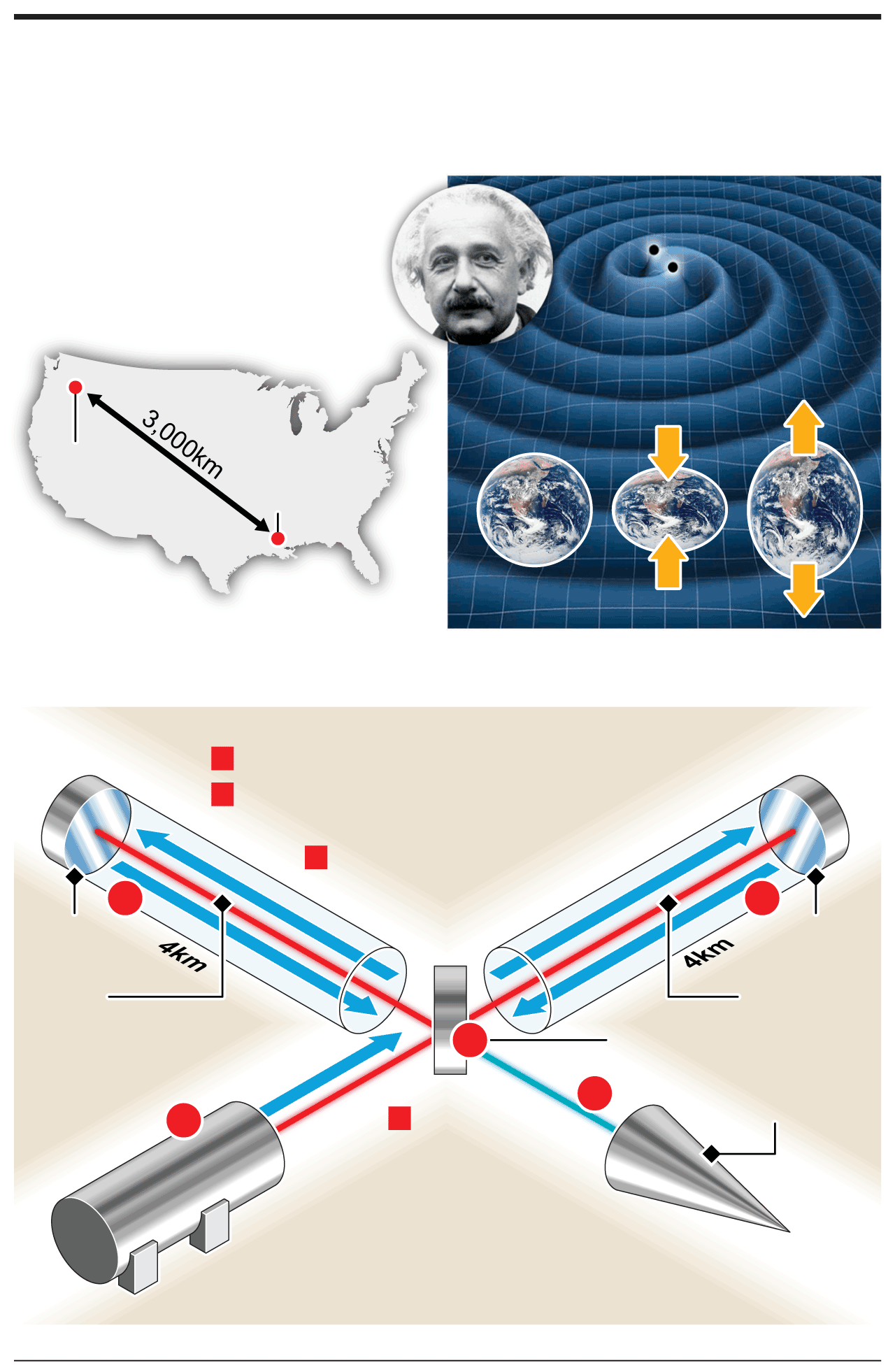
Astronomers say they have finally found elusive gravitational waves, the mysterious ripples in the fabric of space. As these ripples pass the Earth, local space is alternately stretched and compressed
Gravitational waves:
Concentric
ripples that squeeze and stretch
fabric of space-time, caused by
movement of mass. Predicted
by Albert Einstein in his 1916
General Theory of Relativity
U.S.
Livingston,
Louisiana
Hanford,
Washington
LIGO sites
Two detectors
help sift out terrestrial rumblings,
such as traffic and earthquakes,
from other faint vibrations within space
Effect of gravitational ripples,
hugely exaggerated
LIGO – Laser Interferometer Gravitational Wave Observatory
1
Laser beam fed into machine
2
Laser’s light split in two and sent down
identical, perpendicular 4km tunnels
3
Beams bounce back
and forth between
mirrors
3
3
Mirror
Mirror
Light
storage
arm
Light
storage
arm
Beam
splitter
2
Laser
4
Photodetector
4
Two light
paths recombined
and sent to detector
1
By analysing light reflected
off mirrors it is possible to detect
tiny changes – fractions of width of
an atom – in distance between mirrors
Source: LIGO Caltech
Pictures: Associated Press, NASA
© GRAPHIC NEWS
Gravity waves finally
discovered
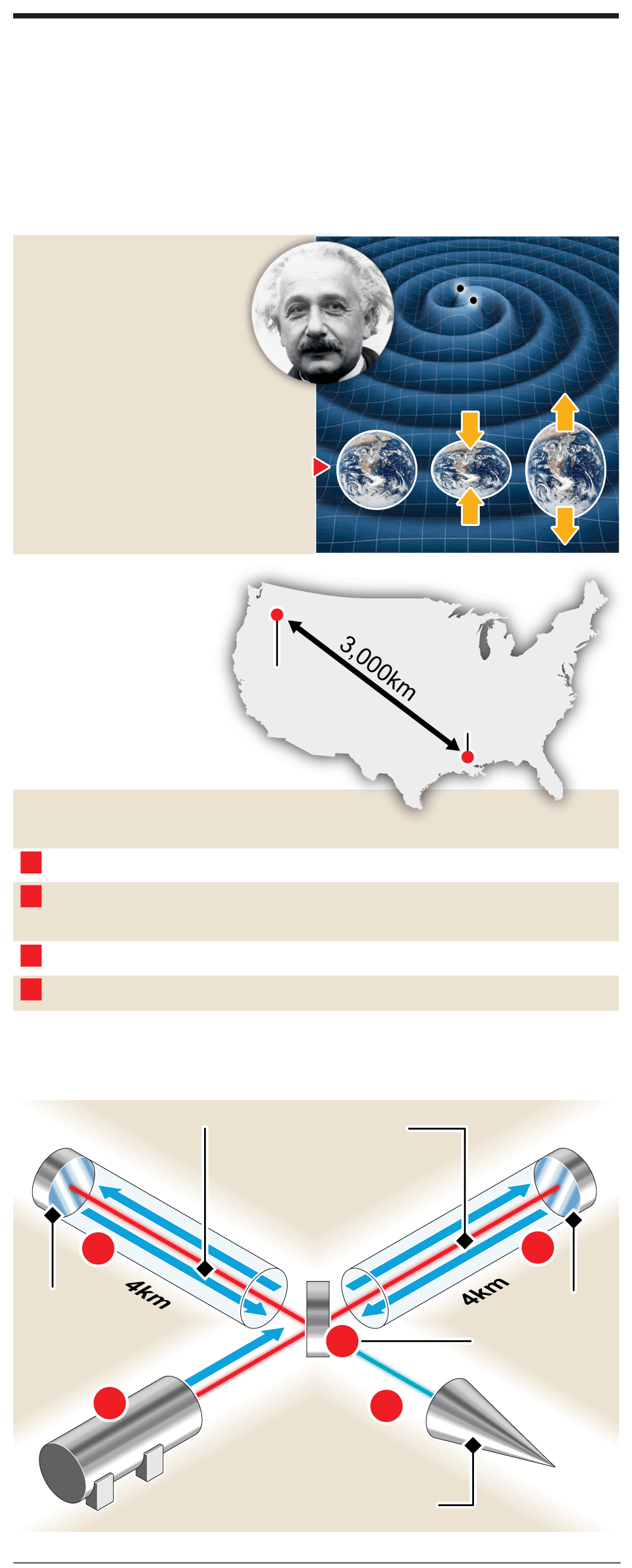
Astronomers say they have finally found elusive gravitational waves, the mysterious ripples in the fabric of space. As these ripples pass the Earth, local space is alternately stretched and compressed
Gravitational waves:
Concentric ripples
that squeeze and
stretch fabric of
space-time, caused
by movement of mass.
Predicted by Albert
Einstein in his 1916
General Theory
of Relativity
Effect of
gravitational
ripples, hugely
exaggerated
LIGO sites
Two detectors help
sift out terrestrial
rumblings, such
as traffic and
earthquakes,
from other faint
vibrations within space
U.S.
Livingston,
Louisiana
Hanford,
Washington
LIGO – Laser Interferometer
Gravitational Wave Observatory
1
Laser beam fed into machine
2
Laser’s light split in two and sent down identical,
perpendicular 4km tunnels
3
Beams bounce back and forth between mirrors
4
Two light paths recombined and sent to detector
By analysing light reflected off mirrors it is
possible to detect tiny changes – fractions of
width of an atom – in distance between mirrors
Light
storage
arm
Light
storage
arm
3
3
Mirror
Mirror
Beam
splitter
2
Laser
1
4
Photodetector
Source: LIGO Caltech
Pictures: AP, NASA
© GRAPHIC NEWS
Gravity waves
finally
discovered
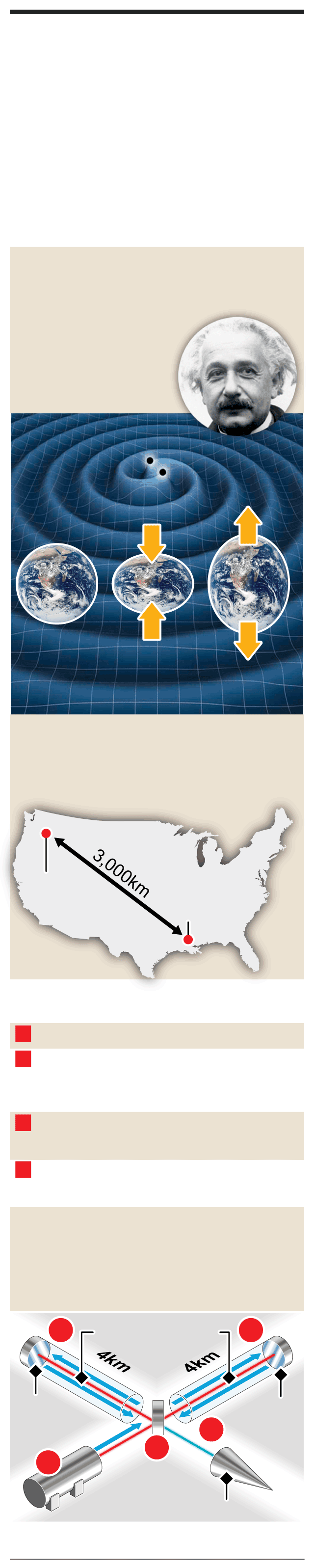
Astronomers say they have finally found elusive gravitational waves, the mysterious ripples in the fabric of space. As these ripples pass the Earth, local space is alternately stretched and compressed
Gravitational waves:
Concentric
ripples that squeeze and stretch
fabric of space-time, caused
by movement of mass.
Predicted by
Albert Einstein in
his 1916 General
Theory of Relativity
Effect of gravitational ripples,
hugely exaggerated
LIGO sites:
Two detectors
help sift out terrestrial rumblings,
such as traffic and earthquakes,
from other faint vibrations
within space
U.S.
Livingston,
Louisiana
Hanford,
Washington
LIGO – Laser Interferometer
Gravitational Wave Observatory
1
Laser beam fed into machine
2
Laser’s light split in two and
sent down identical,
perpendicular 4km tunnels
3
Beams bounce back and forth
between mirrors
4
Two light paths recombined
and sent to detector
By analysing light reflected off
mirrors it is possible to detect
tiny changes – fractions of
width of an atom – in distance
between mirrors
Light storage
arms
3
3
Mirror
Mirror
4
Laser
2
1
Beam
splitter
Photodetector
Pictures: AP, NASA
Source: LIGO Caltech
© GRAPHIC NEWS