SpaceX rocket landing
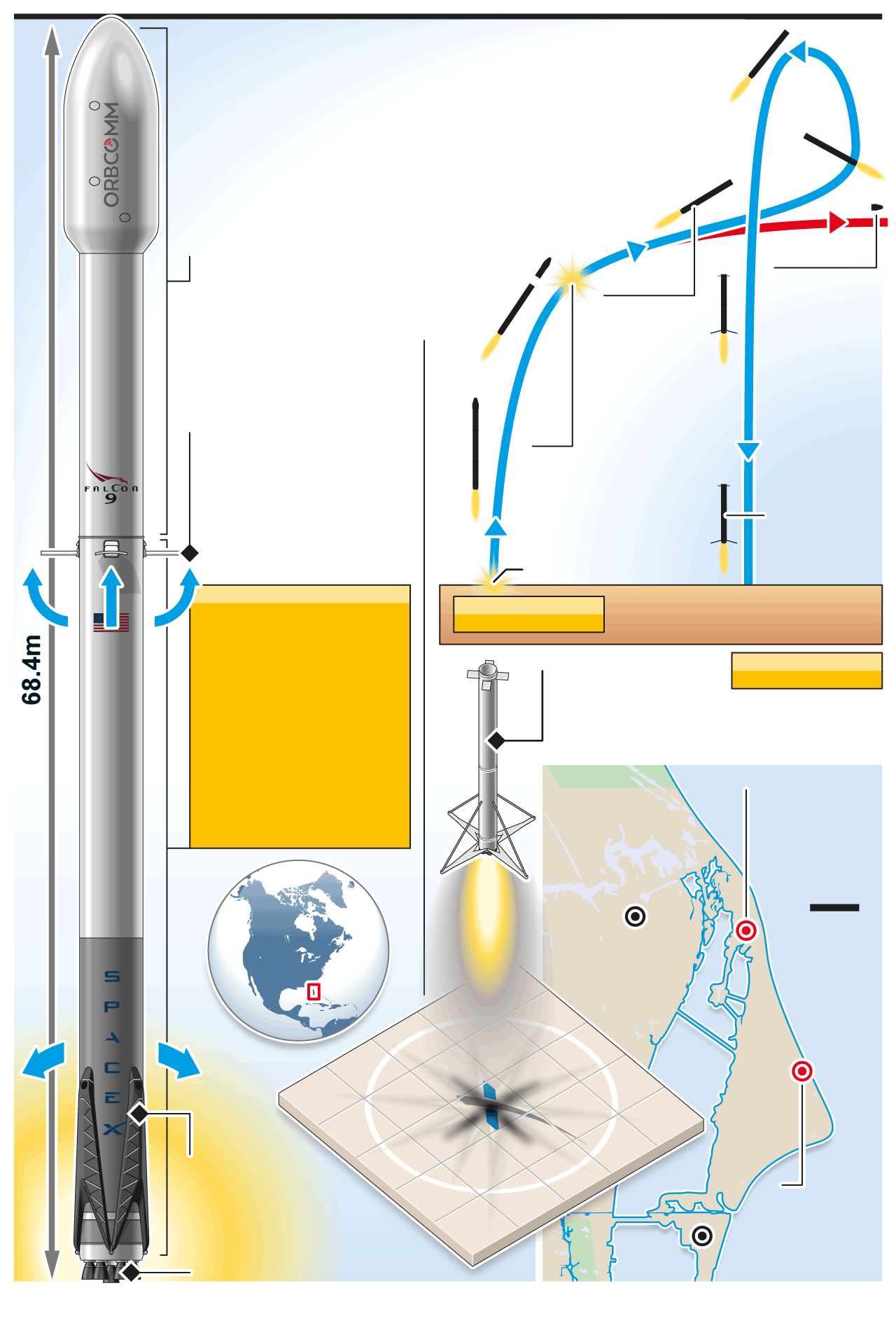
SpaceX has successfully landed an unmanned rocket upright, after sending 11 satellites into orbit. It is the second booster to achieve the feat after the smaller New Shepard rocket landed in Texas in November
Second stage (with
composite faring):
Latest mission carried
11 Orbcomm
communication
satellites
Payload
continues
to space
Booster
flips over
before
descent
Hypersonic
grid fins (x4):
Unfold during
descent to
aid stability
Stage
separation
Soft
landing
at LZ-1
Lift-off
from LC-40
First stage
Incorporates nine
Merlin engines –
fuelled by liquid
oxygen and
kerosene – able
to produce up to
1.5 million
pounds of thrust
LAUNCH
First stage:
Rocket must
slow from nearly
5,800km/h to zero
LANDING
Launch
Complex
40
Kennedy
Space
Centre
(LC-40)
3km
1.8 miles
CAPE CANAVERAL
AIR FORCE
STATION
Landing
legs:
down to
stabilise rocket
Fold
Landing
Zone 1
(LZ-1)*
Cape
Canaveral
Merlin engines
*Formerly Space Launch Complex 13
Sources: SpaceX, wire agencies
© GRAPHIC NEWS
SpaceX rocket landing
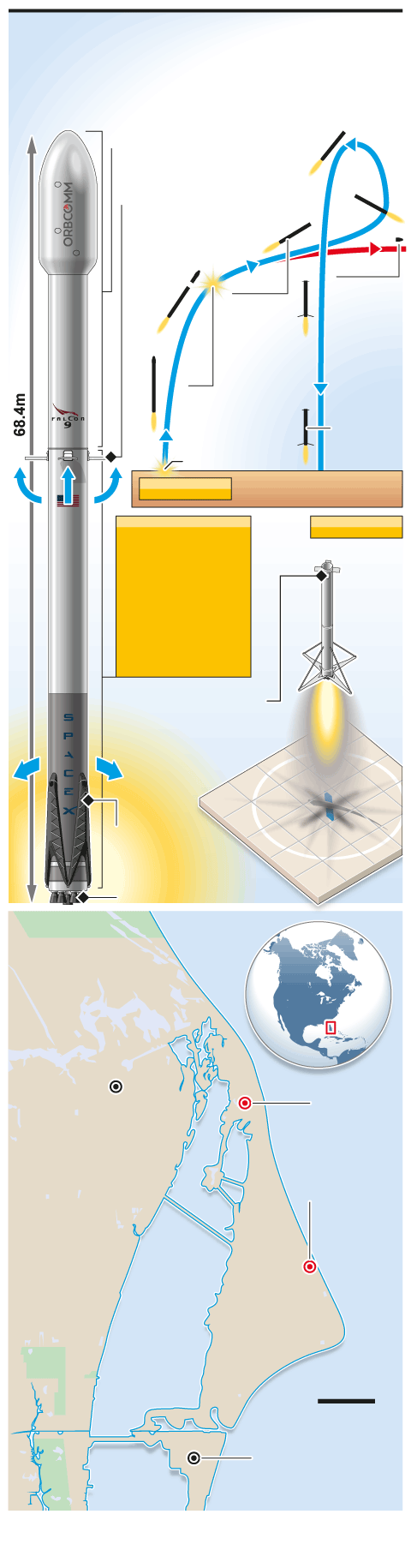
SpaceX has successfully landed an unmanned rocket upright, after sending 11 satellites into orbit. It is the second booster to achieve the feat after the smaller New Shepard rocket landed in Texas in November
Second stage:
Latest mission carried 11
communication satellites
Hypersonic grid fins (x4):
Unfold during descent
to aid stability
Payload
continues
to space
Booster
flips over
before
descent
Stage
separation
Soft
landing
at LZ-1
Lift-off
from LC-40
LAUNCH
LANDING
First stage
Incorporates nine
Merlin engines –
fuelled by liquid
oxygen and
kerosene – able
to produce up to
1.5 million
pounds of thrust
First stage: Rocket
must slow from
nearly 5,800km/h
to zero
Landing
legs:
down to
stabilise rocket
Fold
Merlin engines
Kennedy
Space
Centre
Launch
Complex
40
(LC-40)
Landing
Zone 1
(LZ-1)*
CAPE CANAVERAL
AIR FORCE STATION
3km
1.8 miles
Cape Canaveral
*Formerly Space Launch Complex 13
Sources: SpaceX, wire agencies
© GRAPHIC NEWS

SpaceX rocket
landing
SpaceX has successfully landed an unmanned rocket upright, after sending 11 satellites into orbit. It is the second booster to achieve the feat after the smaller New Shepard rocket landed in Texas in November
Second stage:
Latest mission
carried 11
Orbcomm
communication
satellites
Hypersonic grid
fins (x4):
during descent
to aid stability
Unfold
First stage
Incorporates nine
Merlin engines –
fuelled by liquid
oxygen and
kerosene – able
to produce up to
1.5 million
pounds of thrust
Landing legs:
Fold down to
stabilise rocket
LAUNCH
Merlin
engines
Payload
continues
to space
Booster
flips over
before
descent
Stage
separation
Soft
landing
at LZ-1
Lift-off
from LC-40
LANDING
First stage:
Rocket must
slow from
nearly
5,800km/h
to zero
Launch
Complex
40
(LC-40)
3km
1.8 miles
Kennedy
Space
Centre
CAPE CANAVERAL
AIR FORCE STATION
Landing
Zone 1
(LZ-1)*
Cape
Canaveral
*Formerly Space Launch Complex 13
Sources: SpaceX, wire agencies
© GRAPHIC NEWS