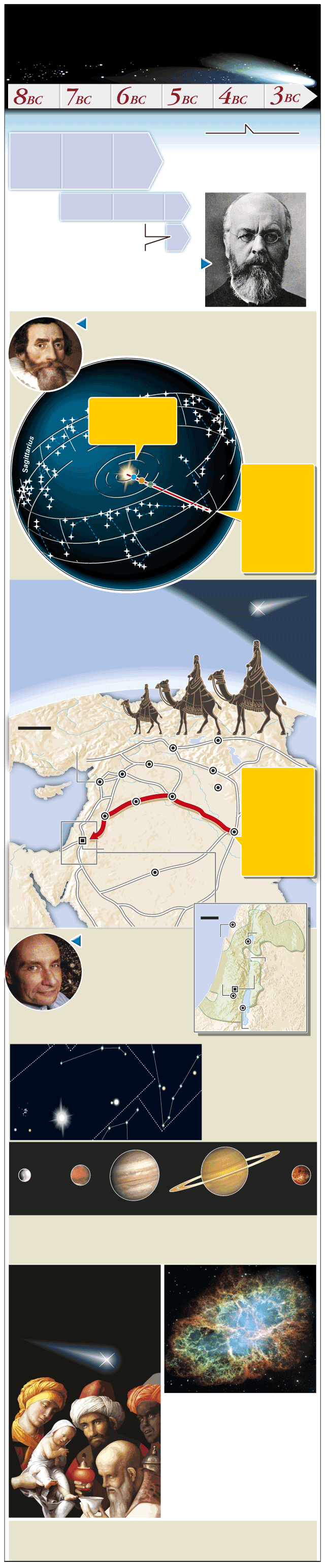
Was the Star of Bethlehem a comet, an alignment between the Sun, the Earth, Jupiter and Saturn, a double eclipse of Jupiter by the moon, supernova or combination of all these events?
STAR OF BETHLEHEM
NATIVITY YEARS
CENSUS
ORDERED
THE STAR
APPEARS
CENSUS
COMPLETE
JESUS
IS BORN?
HEROD DIES
Roman Emperor Caesar Augustus orders census to calculate taxes. Census and tax collection take up to two years to complete
The exact year of Jesus' birth is uncertain, but Gospel of Matthew states the birth occurred in the days of Herod the Great
People return to their place
of birth for census
Joseph and Mary travel to Bethlehem. Magi travel from Babylon to Jerusalem
19th-century scholar Emil Schurer's history of the Jews in the time of Christ establishes that Herod died in 4BC, placing Christ's birth between the census announcement and death of Herod
7BC — Triple conjunction: In 1603 Johannes Kepler observes a conjunction of Jupiter and Saturn in which planets “line up” due to their orbits around the Sun. He calculates that a similar set of circumstances
occurred in 7BC, with a triple conjunction of Jupiter and Saturn in the Constellation of Pisces in May, October and December
Cancer
Leo
Triple conjunction: Sun, Earth, Jupiter and Saturn in line three times in 7BC
Virgo
Gemini
Libra
Sun
Earth
Aries
Jupiter represents King of the Gods, Saturn represents justice and Palestine, while Pisces is associated with Judaism
Saturn
Jupiter
Pisces
Scorpio
Capricorn
Aquarius
Star in the East — According to Matthew, the star appeared twice before it “stood over where the young child was.” The first appearance, most likely the triple conjunction in 7BC, is interpreted by the Magi — Babylonian astrologists — to signify that a Messiah-King will be born in the Israelite kingdom of Judea
200km
Ugarit
Van
Amida
Haleh
Haran
Babylon: Leading centre in astronomy, astrology and mathematics — well aware of Jewish legend that a star will herald the Messiah
Nineveh
Tadmor
Asshur
Mari
Mediterranean
Sea
Fertile
Crescent
trade route
Damascus
Jerusalem
Dumah
40km
Tiberias
Tyre
6BC — Second appearance: Using computer modelling, Rutgers University astronomer Michael Molnar matches Matthew's story to two lunar occultations (eclipses) of Jupiter in the east in 6BC
River
Jordan
Jerusalem
Bethlehem
KINGDOM
OF HEROD
THE GREAT
Masada
The first eclipse of Jupiter in Aries, a constellation also associated with Judea, is on March 20. Second, on April 17, coincides with Jupiter “in the east” and the five visible planets in alignment
PISCES
ARIES
Venus
Saturn
Moon
Pleiades
Jupiter
Sun
Mercury
Mars
EAST
Mercury
Mars
Jupiter
Saturn
Venus
Rare event over Jerusalem — Mike Dworetsky and Steve Fossey of the University of London Observatory calculate that the chance of double eclipses of Jupiter, one month apart, with Mars in Aries would occur about once every 6,000 years
Expectations of a third sign: Could the Star have been a bright comet? Possibly, but Magi would view a comet as an omen of evil — floods, famine and death — not the birth of a King
5BC — The final sign
While translating ancient Chinese astronomical records, 18th-century Jesuit scholar Jean-François Foucquet finds reference to a k'o-hsing or “visiting star” in the eastern sky during March-April 5BC. Chinese astronomers use the term k'o-hsing to describe novae or supernovae, including the stellar explosions of 1006AD, 1054 (Crab Nebula, above), 1572 and 1604
Sources: Kepler and the Star of Bethlehem by W. Burke-Gaffney, The Star of Bethlehem: The Legacy of the Magi by Michael R. Molnar, Lunar Occultations of Jupiter and Saturn by M.M. Dworetsky and S.J. Fossey.
Pictures: Eclipse.net, NASA, ESA, J. Hester (Arizona State University)
© GRAPHIC NEWS

Was the Star of Bethlehem a comet, an alignment between the Sun, the Earth, Jupiter and Saturn, a double eclipse of Jupiter by the moon, supernova or combination of all these events?
STAR OF BETHLEHEM
THE STAR
APPEARS
CENSUS
ORDERED
CENSUS
COMPLETE
JESUS
IS BORN?
HEROD
DIES
Roman Emperor Caesar Augustus orders census to calculate taxes. Census and tax collection take up to two years to complete
People return to their place
of birth for census
Joseph and Mary travel to Bethlehem. Magi travel from Babylon to Jerusalem
The exact year of Jesus' birth is uncertain, but Gospel of Matthew states the birth occurred in the days of Herod the Great
19th-century scholar Emil Schurer's history of the Jews in the time of Christ establishes that Herod died in 4BC, placing Christ's birth between the census announcement and death of Herod
7BC — Triple conjunction: In 1603 Johannes Kepler observes a conjunction of Jupiter and Saturn in which planets “line up” due to their orbits around the Sun. He calculates that a similar set of circumstances occurred in 7BC,
with a triple conjunction of Jupiter and Saturn in the Constellation of Pisces in May, October and December
Cancer
Leo
Triple conjunction: Sun, Earth, Jupiter and Saturn in line three times in 7BC
Virgo
Gemini
Libra
Sun
Earth
Aries
Saturn
Pisces
Jupiter
Scorpio
Capricorn
Aquarius
Jupiter represents King of the Gods, Saturn represents justice and Palestine, while Pisces is associated with Judaism
Star in the East — According to Matthew, the star appeared twice before it “stood over where the young child was.” The first appearance, most likely the triple conjunction in 7BC, is interpreted by the Magi — Babylonian astrologists — to signify that a Messiah-King will be born in the Israelite kingdom of Judea
200km
Tabriz
Van
Ugarit
Amida
Haleh
Haran
Nineveh
Babylon: Leading centre in astronomy, astrology and mathematics
Tadmor
Mari
Mediterranean
Sea
Fertile
Crescent
trade route
Damascus
Jerusalem
40km
Tiberias
Tyre
River
Jordan
Jerusalem
Bethlehem
KINGDOM
OF HEROD
THE GREAT
Masada
6BC — Second appearance: Using computer modelling, Rutgers University astronomer Michael Molnar matches Matthew's story to two lunar occultations (eclipses) of Jupiter in the east in 6BC
PISCES
ARIES
Venus
Saturn
Moon
Pleiades
Jupiter
Sun
Mercury
Mars
EAST
The first eclipse of Jupiter in Aries, a constellation also associated with Judea, is on March 20. Second, on April 17, coincides with Jupiter “in the east” and the five visible planets in alignment
Mercury
Jupiter
Mars
Saturn
Venus
Rare event over Jerusalem — Mike Dworetsky and Steve Fossey of the University of London Observatory calculate that the chance of double eclipses of Jupiter, one month apart, with Mars in Aries would occur about once every 6,000 years
Expectations of a third sign: Could the Star have been a bright comet? Possibly, but Magi would view a comet as an omen of evil — floods, famine and death — not the birth of a King
5BC — The final sign
While translating ancient Chinese astronomical records, 18th-century Jesuit scholar Jean-François Foucquet finds reference to a k'o-hsing or “visiting star” in the eastern sky during March-April 5BC. Chinese astronomers use the term k'o-hsing to describe novae or supernovae, including the stellar explosions of 1006AD, 1054 (Crab Nebula, above), 1572 and 1604
Sources: Kepler and the Star of Bethlehem by W. Burke-Gaffney,
The Star of Bethlehem: The Legacy of the Magi by Michael R. Molnar, Lunar Occultations of Jupiter and Saturn by M.M. Dworetsky and
S.J. Fossey. Pictures: Eclipse.net, NASA, ESA, J. Hester (Arizona State University)
© GRAPHIC NEWS

Was the Star of Bethlehem a comet, an alignment between the Sun, the Earth, Jupiter and Saturn, a double eclipse of Jupiter by the moon, supernova or combination of all these events?
STAR OF BETHLEHEM
CENSUS
COMPLETE
CENSUS
ORDERED
THE STAR
APPEARS
JESUS
IS BORN?
HEROD
DIES
Roman Emperor Caesar Augustus orders census to calculate taxes. Census and tax collection take up to two years to complete
People return to their place of birth for census
Joseph and Mary travel to Bethlehem. Magi travel from Babylon to Jerusalem
The exact year of Jesus' birth is uncertain, but Gospel of Matthew states the birth occurred in the days of Herod the Great
19th-century scholar Emil Schurer's history of the Jews in the time of Christ establishes that Herod died in 4BC, placing Christ's birth between the census announcement and death of Herod
7BC — Triple conjunction: In 1603 Johannes Kepler observes a conjunction of Jupiter and Saturn in which
planets “line up” due to their orbits around the Sun. He calculates that a similar set of circumstances occurred in 7BC, with a triple conjunction of Jupiter and Saturn in the Constellation of Pisces in May, October and December
Triple conjunction: Sun, Earth, Jupiter and Saturn in line three times in 7BC
Cancer
Leo
Virgo
Gemini
Libra
Sun
Earth
Aries
Saturn
Pisces
Jupiter
Scorpio
Capricorn
Aquarius
Jupiter represents King of the Gods, Saturn represents justice and Palestine, while Pisces is associated with Judaism
Star in the East — According to Matthew, the star appeared twice before it “stood over where the young child was”
300km
Amida
Ugarit
Van
Nineveh
Mari
Med.
Sea
Tadmor
Damascus
Babylon
Jerusalem
40km
Tiberias
Tyre
River
Jordan
Jerusalem
Bethlehem
KINGDOM
OF HEROD
THE GREAT
Masada
The first appearance of the star, most likely the triple conjunction in 7BC, is interpreted by the Magi — Babylonian astrologists — to signify that a Messiah-King will be born in the Israelite kingdom of Judea
6BC — Second appearance: Using computer modelling, Rutgers University astronomer Michael Molnar matches Matthew's story to two lunar occultations (eclipses) of Jupiter in the east in 6BC
PISCES
ARIES
Venus
Moon
Saturn
Pleiades
Jupiter
Sun
Mercury
Mars
EAST
The first eclipse of Jupiter in Aries, a constellation also associated with Judea, is on March 20. Second, on April 17, coincides with Jupiter “in the east” and the five visible planets in alignment
Mercury
Mars
Jupiter
Saturn
Venus
Rare event over Jerusalem — Mike Dworetsky and Steve Fossey of the University of London Observatory calculate that the chance of double eclipses of Jupiter, one month apart, with Mars in Aries would occur about once every 6,000 years
Expectations of a third sign: Could the Star have been a bright comet? Possibly, but Magi would view a comet as an omen of evil — floods, famine and death — not the birth of a King
5BC — The final sign
While translating ancient Chinese astronomical records, 18th-century Jesuit scholar Jean-François Foucquet finds reference to a k'o-hsing or “visiting star” in the eastern sky during March-April 5BC. Chinese astronomers use the term k'o-hsing to describe novae or supernovae, including the stellar explosions of 1006AD, 1054 (Crab Nebula, above), 1572 and 1604
Sources: Kepler and the Star of Bethlehem by W. Burke-Gaffney, The Star of Bethlehem: The Legacy of the Magi by Michael R. Molnar, Lunar Occultations of Jupiter and Saturn by M.M. Dworetsky and S.J. Fossey.
Pictures: Eclipse.net, NASA, ESA, J. Hester (Arizona State University)
© GRAPHIC NEWS