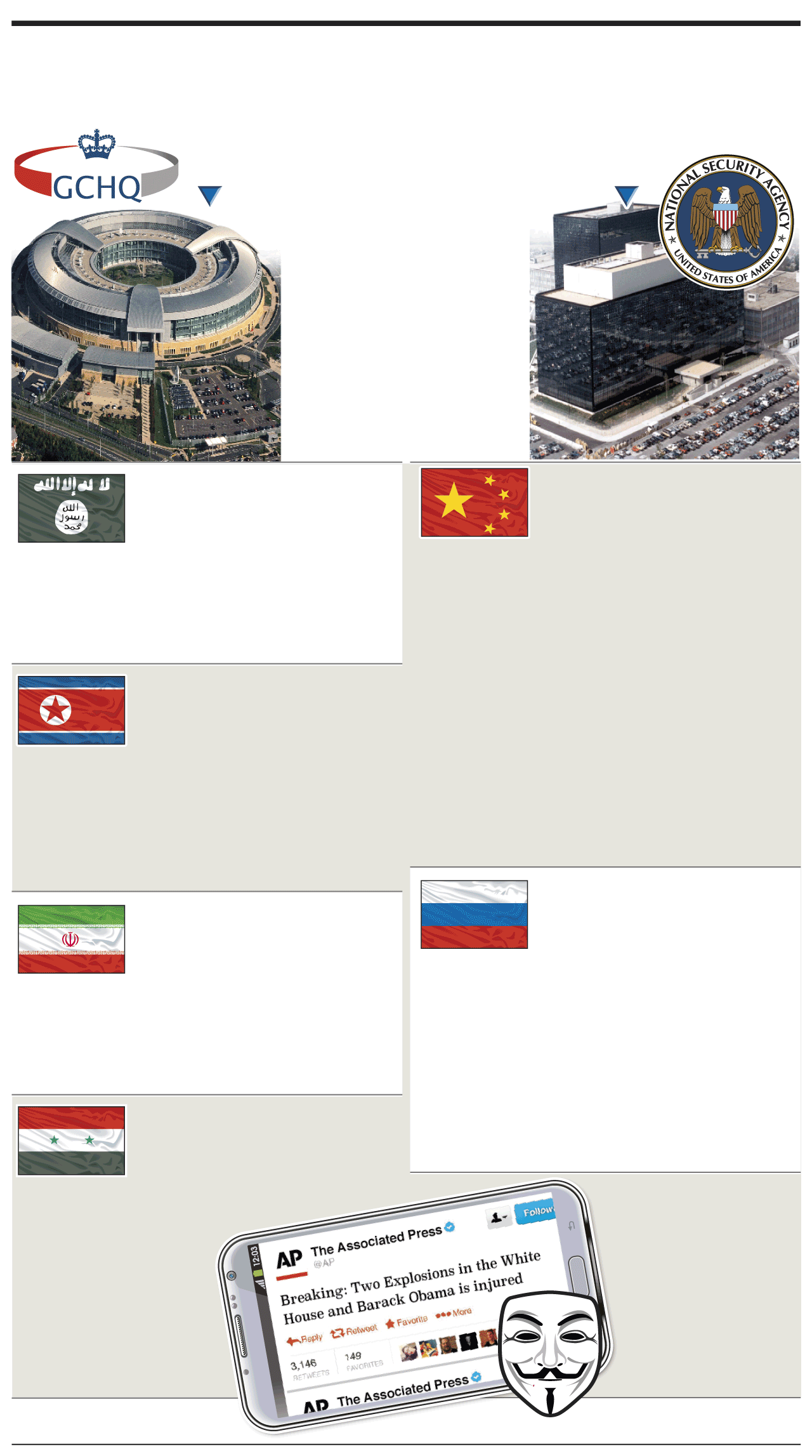
Key players in cyber-espionage world

Britain: Government
Communications HQ

United States: National
Security Agency

Malware programmes such as Warriorpride and Regin are used by Five Eyes — U.S., UK, Canada, Australia and New Zealand — to collect intelligence from email, video, voice and keystroke data

Islamic State: Uses Telegram messaging app which has

China: Hidden Lynx “hackers for hire” group specialises in

end-to-end encryption, channels and self-destruct feature. IS Nashir channel has 11,700 followers in four languages

attacks on financial and defence sectors.
Shanghai-based PLA Unit 61398 targets U.S. intellectual property, business emails, and contacts.
Putter Panda (Unit 61486) has mounted cyber attacks on Canadian, U.S. and EU aerospace companies. In July 2015
Deep Panda stole personal data of 21.5 million U.S. Federal employees

North Korea: Around 1,800 army hackers within Bureau 121

assembled to attack financial institutions and media companies in South Korea, Japan, and U.S. Believed to have mounted Sony Pictures hack in 2014

Russia: State-sponsored Energetic Bear targets U.S. and

Iran: Tarh Andishan -- consists of at least 20 hackers in Iran with

European critical infrastructure by sabotaging ICS (Industrial Control Systems). BlackEnergy malware toolkit captures screenshots, records audio, and harvests passwords and banking credentials from infected computers

associates in Canada, Netherlands and UK. Group targets critical infrastructure in Europe, North America and Middle East

Syria: Syrian Electronic Army targets media outlets and journalists.

In 2013 SEA hacked Associated Press Twitter account. Fake tweet that White House had been bombed resulted in markets falling by $136bn

Anonymous: Linked to hacks on governments in Canada, U.S. and Israel. Has declared war against IS after Paris attacks

Sources: Symantec,
Crowdstrike, F-Secure

© GRAPHIC NEWS
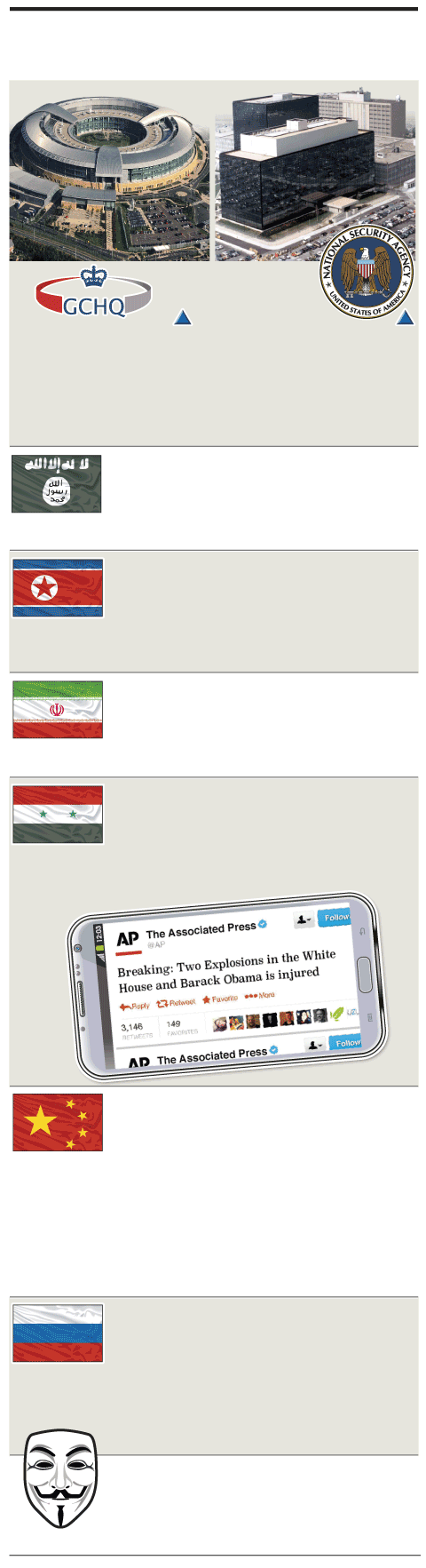
Key players in cyber-espionage world

Britain: Government
Communications HQ

United States: National
Security Agency

Malware programmes such as Warriorpride and Regin are used by Five Eyes — U.S., UK, Canada, Australia and New Zealand — to collect intelligence from email, video, voice and keystroke data

Islamic State: Uses Telegram messaging app which has end-to-end encryption, channels and self-destruct feature. IS Nashir channel has 11,700 followers in four languages

North Korea: Around 1,800 army hackers within Bureau 121 assembled to attack financial institutions and media companies in South Korea, Japan, and U.S. Believed to have mounted Sony Pictures hack in 2014

Iran: Tarh Andishan -- consists of at least 20 hackers in Iran with associates in Canada, Netherlands and UK. Group targets critical infrastructure in Europe, North America and Middle East

Syria: Syrian Electronic Army targets media outlets and journalists. In 2013 SEA hacked Associated Press Twitter account. Fake tweet that White House had been bombed resulted in markets falling by $136bn

China: Hidden Lynx “hackers for hire” group specialises in attacks on financial and defence sectors.
Shanghai-based PLA Unit 61398 targets U.S. intellectual property, business emails, and contacts.
Putter Panda (Unit 61486) has mounted cyber attacks on Canadian, U.S. and EU aerospace companies. In July 2015 Deep Panda stole personal data of 21.5 million U.S. Federal employees

Russia: State-sponsored Energetic Bear targets U.S. and European critical infrastructure by sabotaging ICS (Industrial Control Systems). BlackEnergy malware toolkit captures screenshots, records audio, and harvests passwords and banking credentials from infected computers

Anonymous: Linked to hacks on governments in Canada, U.S. and Israel. Has declared war against IS after Paris attacks

Sources: Symantec, Crowdstrike, F-Secure

© GRAPHIC NEWS

Key players in cyber-espionage world

Britain: Government Communications HQ

United States: National Security Agency

Malware programmes such as Warriorpride and Regin are used by Five Eyes — U.S., UK, Canada, Australia and New Zealand — to collect intelligence from email, video, voice and keystroke data

Islamic State: Uses Telegram messaging app which has end-to-end encryption, channels and self-destruct feature. IS Nashir channel has 11,700 followers in four languages

North Korea: Around 1,800 army hackers within Bureau 121 assembled to attack financial institutions and media companies in South Korea, Japan, and U.S. Believed to have mounted Sony Pictures hack in 2014

Iran: Tarh Andishan -- consists of at least 20 hackers in Iran with associates in Canada, Netherlands and UK. Group targets critical infrastructure in Europe, North America and Middle East

Syria: Syrian Electronic Army targets media outlets and journalists. In 2013 SEA hacked Associated Press Twitter account. Fake tweet that White House had been bombed resulted in markets falling by $136bn

China: Hidden Lynx “hackers for hire” group specialises in attacks on financial and defence sectors.
Shanghai-based PLA Unit 61398 targets U.S. intellectual property, business emails, and contacts.
Putter Panda (Unit 61486) has mounted cyber attacks on Canadian, U.S. and EU aerospace companies. In July 2015 Deep Panda stole personal data of 21.5 million U.S. Federal employees

Russia: State-sponsored Energetic Bear targets U.S. and European critical infrastructure by sabotaging ICS (Industrial Control Systems). BlackEnergy malware toolkit captures screenshots, records audio, and harvests passwords and banking credentials from infected computers

Anonymous: Linked to hacks on governments in Canada, U.S. and Israel. Has declared war against IS after Paris attacks

Sources: Symantec, Crowdstrike, F-Secure

© GRAPHIC NEWS