Solar winds stripped Mars’ atmosphere

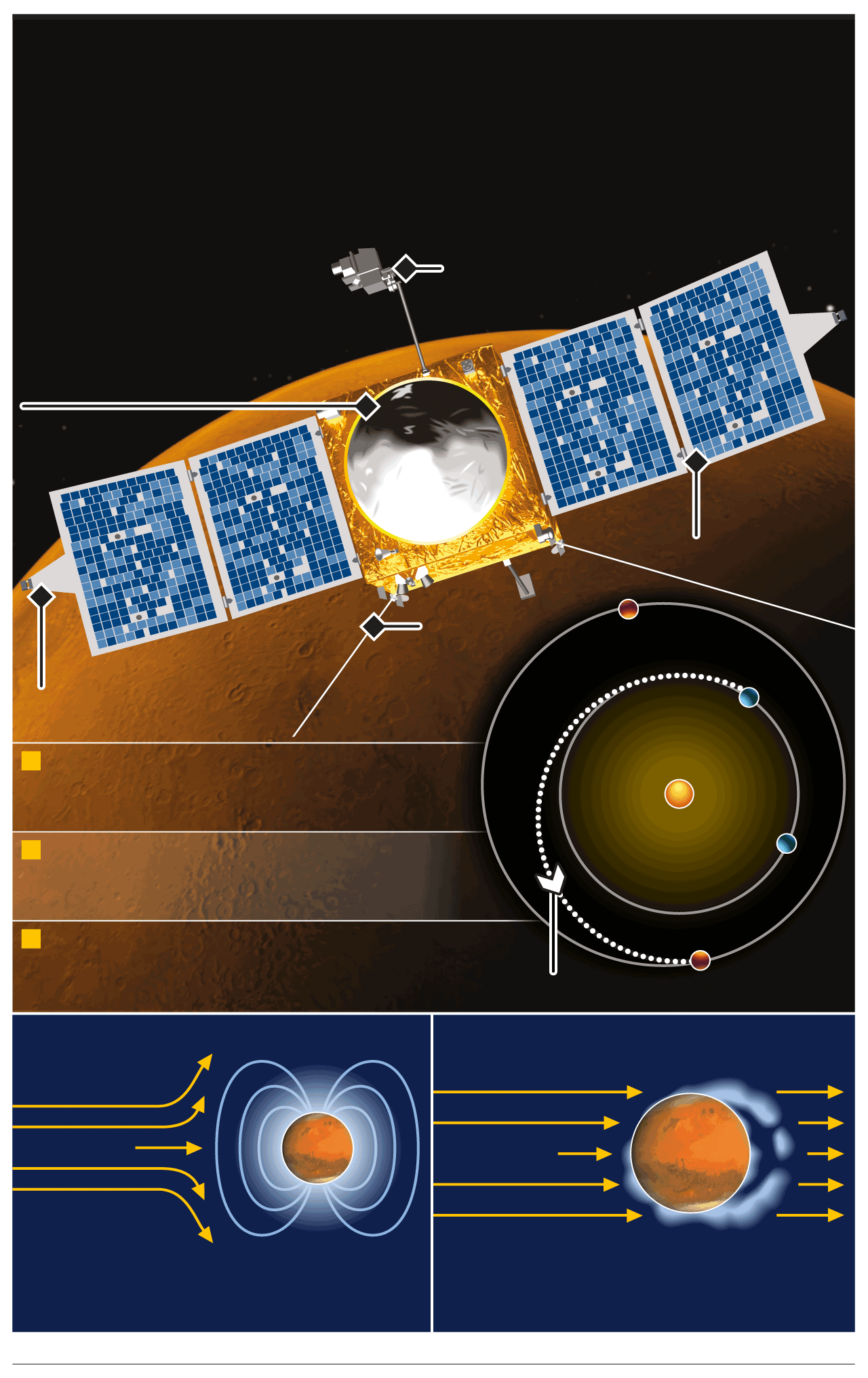
NASA’s MAVEN spacecraft has observed the direct impact of a solar storm on Mars’ atmosphere, showing that solar particles energised gases in the upper atmosphere, causing them to blast into space – stripping the planet of its once-thick, water-rich atmosphere

MAVEN SPACECRAFT

Launch weight:

2,550kg

Articulated payload

platform

High-gain antenna:

Diameter 2.1m

“Gull-wing”

solar array

LPW*

boom

Mars at

launch

Magnetometer boom

*Langmuir

Probe and

Waves

Launch

Nov 2013

INSTRUMENTS

Particles and Fields Package

Six sensors for studying solar wind,

Martian ionosphere and magnetic field

Sun

Remote Sensing Package

Earth

orbit

Measures global characteristics of

upper atmosphere and ionosphere

Neutral Gas and Ion Mass Spectrometer

Measures composition of upper

atmosphere

MAVEN orbit

Arrival Sep 2014

EARLY MARS

MARS ATMOSPHERE LOSS

Magnetic field

Atmosphere

Solar wind

Solar wind

Warmer planetary core generates

stronger magnetic field, protecting

atmosphere from solar wind

Decline of magnetic field due to core

cooling. Atmosphere slowly stripped

away by solar wind

Source: NASA

Picture: NASA’s Goddard Space Flight Centre

© GRAPHIC NEWS

Solar winds stripped Mars’ atmosphere

NASA’s MAVEN spacecraft has observed the direct impact of a solar storm on Mars’ atmosphere, showing that solar particles energised gases in the upper atmosphere, causing them to blast into space – stripping the planet of its once-thick, water-rich atmosphere

MAVEN SPACECRAFT

Launch weight:

2,550kg

Articulated payload

platform

High-gain antenna:

Diameter 2.1m

“Gull-wing”

solar array

LPW* boom

Mars at launch

Magnetometer

boom

*Langmuir Probe

and Waves

INSTRUMENTS

Particles and Fields Package

Launch

Nov 2013

Six sensors for studying solar

wind, Martian ionosphere and

magnetic field

Sun

Earth

orbit

Remote Sensing Package

Measures global characteristics of

upper atmosphere and ionosphere

Neutral Gas and Ion Mass

Arrival

Sep 2014

Spectrometer:

Measures

MAVEN

orbit

composition of upper atmosphere

EARLY MARS

MARS ATMOSPHERE LOSS

Magnetic

field

Atmosphere

Solar wind

Solar wind

Warmer planetary core

generates stronger magnetic

field, protecting atmosphere

from solar wind

Decline of magnetic field

due to core cooling.

Atmosphere slowly stripped

away by solar wind

Source / Picture: NASA

© GRAPHIC NEWS

Solar winds stripped Mars’ atmosphere

NASA’s MAVEN spacecraft has observed the direct impact of a solar storm on Mars’ atmosphere, showing that solar particles energised gases in the upper atmosphere, causing them to blast into space – stripping the planet of its once-thick, water-rich atmosphere

MAVEN SPACECRAFT

Launch weight:

2,550kg

“Gull-wing”

solar array

Articulated

payload

platform

High-gain

antenna:

Diameter

2.1m

LPW*

boom

*Langmuir

Probe and

Waves

Magnetometer boom

INSTRUMENTS

Particles and Fields Package

Six sensors for studying solar wind,

Martian ionosphere and magnetic field

Remote Sensing Package

Measures global characteristics of

upper atmosphere and ionosphere

Neutral Gas and Ion Mass

Spectrometer:

Measures composition

of upper atmosphere

MISSION

Mars at

launch

Launch

Nov 2013

Sun

Earth

orbit

MAVEN orbit

Arrival Sep 2014

EARLY MARS

Magnetic field

Solar wind

Warmer planetary core generates

stronger magnetic field, protecting

atmosphere from solar wind

MARS ATMOSPHERE LOSS

Atmosphere

Solar wind

Decline of magnetic field due to core

cooling. Atmosphere slowly stripped

away by solar wind

Source / Picture: NASA

© GRAPHIC NEWS
